Tuesday, 18 March 2014

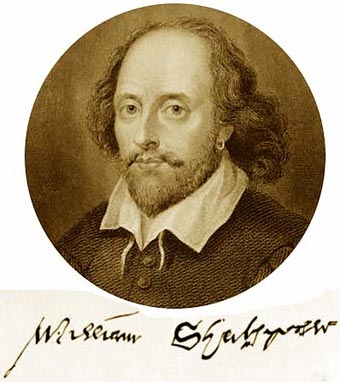
Shakespeare boom - a reading lesson.

In one of my previous posts I blogged about using literature in EFL and gave an example lesson plan based around Hamlet's soliloquy. I also said I would post a lesson plan I tend to do before the actual soliloquy class as it provides a good introduction to Shakespeare and his plays - so here it is. Not as soon as I promised it would land here, but better late than never.

I've tried to follow the tips for designing better skills lesson which I blogged about here in: "Let's bring back the TAPES." I built in reflection stages into the lesson plan, because I believe that whenever possible we should give our learners the tools they can use outside the class to better tackle similar texts (Techniques-oriented). I used authentic material and tried to make the tasks authentic too (Authentic). The tasks are Purposeful and fit into the overall lesson aims, so the learners should feel a sense of achievement. Finally, I tried to make the tasks Engaging by for example, getting the learners to read the text for the information chosen by them (see Task 2).

This lesson is suitable for any level from Intermediate above, although certain exercises might need adapting (see IDEAS)and more, or less, scaffolding depending on the students' level. It takes approximately 120 mins.

And please do comment below if you have any ideas how to improve/change the lesson plan. I'd also love to hear how it went down with your students.

Primary lesson aims:

  • to introduce students to Shakespeare and his plays
  • to show students how to read and understand a difficult text through reflecting on the process
  • to practise inferring the meaning of difficult words from context

Lesson procedure

Task 1 Discussion


In pairs/threes discuss these questions:
  • What do you know about Shakespeare?
  • When and where was he born?
  • What made him famous?
  • Do you know titles of any of his plays?
  • Have you ever seen Shakespeare on stage?

Task 2 Reading/Speaking

You are going to read parts of Shakespeare’s biography: prepare a list of facts that you would like to find out more about. Read the text quickly to find ONLY the information you’re interested in. Exchange the information with your partner.

(IDEA: you can use any bio note you think will do the trick. I tend to cut it up into paragraphs and set them up around the room so that students have to move around and quickly look for the information. Set a strict time limit so they don't end up reading everything in detail. This activity is supposed to raise their curiosity and motivation as they read the text to find the information THEY are interested in.)


Task 3 Gist reading

Read the text below quickly. Don’t stop on difficult words. You have 1 minute. Answer the question: Is Shakespeare and his works still popular nowadays?

(IDEA: you should be strict about the time limit. The text is very challenging, but the students should be able to answer the gist question. You can scaffold it by asking: Will you read the whole text? Will you stop on difficult words? Where are you likely to find the main idea?)

Task 4 Reflection #1

Discuss these questions:
  • Did you have time to read everything?
  • Why did I ask you to read so quickly?
  • Were you able to understand the main idea of the text?
  • Is such reading similar to how you sometimes read in your mother tongue (e.g. when you don't have much time)?

Task 5 Gist reading #2 (paragraphs)


Read the statements below and decide if they adequately summarise each paragraph. Remember you don’t have to read every paragraph in detail. Look for its main message or summary. And don’t stop on difficult vocabulary.

  • Paragraph 1: Most scientists think there is a Shakespeare boom.
  • Paragraph 2: Shakespeare has always been and still is present in the literary canon.
  • Paragraph 3: Shakespeare’s plays are still incredibly popular. 

Task 6: Reflection #2

Discuss these questions:
  • How was the second reading different from the previous one?
  • Was it more difficult or easier?
  • Was it necessary to understand all the words?
  • Where in the paragraph can you usually find the main idea?

Task 7: Reading for implicit meaning


Answer these questions by choosing the correct option: a), b), c) or d). There is only ONE correct answer. Before you start reading, underline the key words in the questions and the answers.

1.     The comical impact of the soliloquy scene was: a) part of the film   b) was due to Branagh acting skills c) was not intentional d) made everyone in the audience laugh
2.     According to the text the mountain backdrop: a) looked artificial  b) greatly impressed the writer c) was not part of the scenery d) looked very real
3.     After the soliloquy: a) loud laughter could be heard b) the audience remained silenced c) everyone was in awe d) a few people laughed even though the scene was not meant to be funny
4.     Shakespeare’s recent popularity: a) is due to the re–introduction of his plays into school curricula b) is not going to be long–lasting c) is derided by experts interviewed by the author d) is only the author’s biased opinion
      5. Shakespeare: a) is only widely read by academics b) is thought to have been very tall c) is for Harold  Bloom only a minor writer d) is criticised by some thinkers, while others see him as having similar political views to their own 

(IDEA: if you're pressed for time, you might want to set this task as HW. Be prepared to guide your students. For example, point out to them how they should first eliminate the answers which are illogical. Using their schemata will also help (i.e. we know that the play is serious so the answer that seems more likely in 1 is c)

The text: "Shakespeare boom" by David Gates (Newsweek, 30th December 1996)

At a press screening of Kenneth Branagh's four–hour–long “Hamlet”, we ran into a colleague during the intermission. The lights went up after Branagh had bellowed out the “How all occasions do inform against me” soliloquy, with martial music blaring, in front of a bogus–looking mountain backdrop. Under all the din, a few titters had been audible. “Well”, said our colleague, “this ought to put a stop to the Shakespeare boom.” Maybe, maybe not. But we were relieved that somebody else thought there was a Shakespeare boom. So many of the scholars we’d interviewed had given us the old horselaugh. The Bard is back? Was that our angle? (Par 1)


The truth is, he never went away. A couple of years ago the multiculturalists had supposedly frog–marched him out of school curriculums. Yet in his native England, every kid must now read two plays and take a national exam; no mass suicides reported. In the United States he's still studied in more than 90 percent of high schools. In universities, postcolonialists, feminists and specialists in “queer studies” rope him in as either a fellow subversive or No. 1 whipping boy. While the writer whom critic Harold Bloom has pronounced “the center of the canon” may never again bestride the narrow world like a colossus, he gets around OK for a 400–year–old. (Par 2) 
In New York the week before Christmas you could see three new Shakespeare films–not counting “Hamlet”, which opens Christmas Day. Former Royal Shakespeare Company director Trevor Nunn offers a handsome, splendidly acted „Twelfth Night.” Al Pacino's “Looking for Richard” is half “Richard III” and half a film about filming „Richard III.” And Australian director Baz Luhrmann's post–MTV „Romeo & Juliet” has car crashes, gun battles and Mercutio as a black drag queen. In London they're building, on the original site, a replica of the Globe Theatre, where Shakespeare's own company performed–and he himself supposedly played Old Hamlet's ghost. Already more than 300,000 people have attended performances in the uncompleted structure. This month an organization of travel journalists voted it the top tourist attraction in Europe. (Par 3)

Task 8: Inferring meaning of difficult words from context


Look at paragraph 1. Find the words: to run into and to bellow out.

Use the 4 step method to work out their meaning and match them to the definitions a) to c):

a) to meet by accident

b) to shout in a loud voice

4 step method: Working out meaning from context:

1.     Think about the wider context of the text and the paragraph.

2.     Look at some words that come immediately AFTER and BEFORE the difficult word. Do they give you some clues about the meaning?

3.      Identify the part of speech and think of a synonym that could be used to replace the difficult word.

4.     Finally, check the meaning in a dictionary. Was your definition similar?

Now read the text more carefully and find the words which mean:

1.     fake, not real (par 1) __________

2.     a loud confused and unpleasant noise which lasts for a long time (par 1) __________

3.     to laugh nervously often knowing you shouldn’t be laughing (par 1) __________

4.     a loud and usually derisive laugh (par 1) __________

5.     a position from which something is viewed (par 1) __________

6.     to force sb to move forward by holding their arms behind their back (par 2) ________

7.     strange, unusual (par 2) __________

8.     to persuade sb to do sth for you (par 2) __________

9.     trying to destroy or damage sth, especially an established political system (par 2) __________

10. sb or sth that is blamed for problems caused by others (par 2) __________

11. to sit or stand with a leg on either side of an animal or object (par 2) __________
Now in pairs cover the words or the definitions and test each other on the vocabulary. Do you know how to use those words in a sentence?

Task 9 Controlled speaking: vocabulary activation

Retell the text to your partner. Use as many words from the text as possible. You get 1 point for each correctly used word. Who got more points?

(IDEA: you could use some more activities to review and practise the words 1-11 using one of the activities I described in my post about recycling lexis. For alternative or additional ways of clarifying meaning of difficult vocabulary, if the context and definitions are not enough, you can check this post.)

Task 10: Reflection #3

  • When reading a difficult text for the first time, should you focus on the main message or the details?
  • How was each reading task different and how can you use this approach to read at home?
  • Is it necessary to understand all the words to be able to understand a text?
  • When you're reading in your mother language and you see a word you don't know, what do you do? Do you immediately look it up in a dictionary?
  • How can context help you understand the meaning of unknown words?

Task 10 Speaking/Discussion

  • Is Shakespeare also popular in your country? Why (not)? 
  • Which plays have you seen or read? Which would you like to see or read? 
  • Why do you think Shakespeare’s plays are still so popular after 400 years?
  • Do you have an author in your country who is very popular?
  •  Do you like movies based on books or plays? Why (not)? Which have you seen?

Wednesday, 5 March 2014

10 proofreading tips

Recently I've been teaching quite a lot of Academic Writing and exam preparation, and something which will perhaps sound obvious when I say it - or perhaps not - has become apparent. Namely, proofreading your own work can be really challenging.

If it's been a while since you wrote something other than a few informal emails, FB and text messages, you might have forgotten how difficult proofreading can actually be. As a teacher, spotting your students mistakes is a piece of cake. But spotting your own...

And if we put ourselves in the position of a student who's still grappling with the grammar, spelling and punctuation (apart from trying to make their writing coherent and use all the damn linkers their teacher insists on), the challenge becomes even greater.

There are numerous correction techniques we can use as teachers to give our students feedback on their writing, and I'm hoping to blog about them quite soon. What I want to explore here, however, is how to help our learners to avoid making the mistake in the first place through improving their proofreading skills - something which has never really occurred to me before and which I think is rather neglected in teaching writing.

For example, as a language student - both at university and in language schools - I've never really been taught how to check my work for mistakes. But told to do so anyway by the teacher. So as most of us, I've picked it up as I went along, through trial and error. And as a teacher, I've also never really taught my students how to proofread their writing before handing it in although I've always expected them to do it.

So here's a not-altogether-exhaustive list of 10 proofreading tips. I'm planning to go through with some of my students to see if it helps improve their quality of writing. I've also tried to apply them to this post, but do let me know if you spot any mistakes.
  1.  Take a break:

    If you've been toiling over your written assignment for quite some time now, you've probably become so familiar with it that you won't be able to spot any mistakes. Your ideas will sound crystal clear and perfectly logical. But probably you will be seeing what you think you wrote rather than what's actually on paper. So setting the text aside can help you clear your mind and see it anew when you get back to it. Ideally, sleep on it. If you're in a rush, relax for as long as you can, before proofreading. Try closing your eyes for 5 minutes and clearing your mind. Or gaze through the window and think about something else.
  2. Print it:

    I'm not sure why, but it's much more difficult to proofread on the screen. Perhaps because if you've been writing the text on your computer, your eyes are probably already quite tired. Printing it might also help you see your writing from a different angle. A fresh perspective. Try it. It definitely works.
  3. One thing at a time:

    Remember - it's not a sprint (although in an exam situation you might be pressed for time). Divide the process of proofreading into several stages. This will enable you to focus on a particular aspect (e.g. punctuation; subject/verb agreement) more closely and increase your chances of spotting the mistakes. Also, shifting your focus should help you stay concentrated and fresh for longer, as you will be looking at different and new aspects of your writing at each proofreading stage.
  4. Check the flow:

    Before you start looking at language mistakes, read the text for the overall meaning. Check if it's logical. Try to put yourself in the shoes of somebody who knows little or nothing about the topic. The best texts are the least convoluted ones. If you're writing an argumentative essay, play the devil's advocate to see if you've used solid and convincing argumentation.
  5. Typical mistakes first:

    Prepare a list of the most typical and recurring mistakes that you've made in your recent assignments. Alternatively, ask your teacher  for help. Don't go for too many. Select maybe 5 that are the most persistent. Have this list in front of you and focus first only on the mistakes listed there. They can be quite difficult to spot, because you might have made them so many times that they seem correct to your brain. So read the text carefully. Once you're happy the typical mistakes are out, proofread again for other errors.
  6. Read it backwards:

    I'm not joking. Try it. Reading it word by word from back to front will shift your attention from the content to the text itself. This should help you spot some spelling, punctuation and grammar mistakes which have so far been overlooked.
  7. Read it aloud:

    And backwards! No, this time I'm only joking about the last one. But reading aloud can actually be very helpful. You might be able to hear the mistakes you were not able to see. This technique is particularly effective for spotting punctuation errors, run-on sentences and some word endings (e.g. -s).
  8. Don't rely on grammar and spelling checkers:

    Of course, Word spell-checker for example, can be very helpful. But they also make you lazy. And many mistakes are overlooked by them. For example, "to" and "too" are both perfectly good words, so the error in "I like reading to" will not be underlined. Neither will "His advise was really helpful". Sometimes a correctly spelled word might be underlined because it's not found in the spell checker's dictionary. In short, grammar and spelling checkers are quite smart, but only as far as it goes. So do use them, but don't treat them as the ultimate solution. You will still need to proofread.
  9. The devil's in the details:

    Double-check all the figures, proper names and references. Often one zero missing in a figure can cause a whole lot of problems. Make sure the information given in your text is accurate. Watch out for commonly misused words.
  10. Ask for help:

    If all else fails, ask somebody else to proofread your text (for example, in exchange for one of their texts). It doesn't necessarily mean you have to pay somebody to proofread your work. Even just a quick look by a friend, relative or colleague can often make the difference. They'll be looking at your work with a fresh pair of eyes and are much more likely to spot the mistakes that have escaped you. If you know you have problems with a particular area (e.g spelling), ask your proofreader to focus on it. This should make it more effective and time-efficient.
I hope you can use these 10 tips to improve the quality of your work before your teacher or tutor gets there with a red pen. And as a teacher, you can use these to develop your students' proofreading skills.

If you have any other tips or proofreading techniques that work for you, leave a comment below.

When composing my list, I used these sites:

Saturday, 1 March 2014

Clarifying meaning

From the Author:
Dear All,
The blog has been permanently moved to teflreflections.wordpress.com This particular post can be found here: http://teflreflections.wordpress.com/2014/03/01/clarifying-meaning/ I'm not going to publish anything on the blogspot address any more, and I'll delete the blog within a week or two.
So if you'd still like to follow my posts (I hope you do), please visit the wordpress version and click follow there: teflreflections.wordpress.com You can also find regular updates on the posts on the new blog's FB page by clicking here.
Thanks for reading and commenting on the posts here, and I hope to see you soon on wordpress.
Best,

Marek Kiczkowiak


Saturday, 22 February 2014

(Non–)Nativity scenes


This article was published by the TESOL NNEST Newsletter and you can read it here: http://newsmanager.commpartners.com/tesolnnest/issues/2014-03-11/6.html
For your convenience I post the full article below:


December is still a long way away. Yet I have already been haunted by nativity scenes. Not that I have anything against Christmas, let alone Christianity. It is just that I never thought I would have to admire one nativity (or “nativeness”?) scene after another when reading advertisements for English teachers.

To put the enormity of the problem into perspective, over 50% of jobs advertised in the European Union (excluding the United Kingdom, where schools know that a birth certificate should not be confused with a teaching qualification) on tefl.com, the biggest search engine for job-seeking English teachers, are native speakers only. If you are still not convinced that we are talking discrimination here, then ask yourself this simple question: How would you feel if over 50% of the ads you looked at listed as a qualification: all applicants must be WHITE MALES?

And Holland, where I am currently based, is on an infamous par with the rest of the EU. All top-notch language schools. All flaunting teaching excellence. Yet all stress that only native speaker teachers (NESTs) need apply. What is shocking is their cheek and absolute lack of logic. To quote one recruiter, whom I informed that he had illegally turned down my application for a teaching position as I was not a native speaker of English: “This is not discrimination against a particular nationality in any way. We require our French teachers to be native speakers of French, whatever their nationality, and our Spanish teachers to be native speakers of Spanish, again whatever their nationality, just as we expect our Polish teachers to be native speakers of Polish, etc.”

How about leaving the birth certificate in the drawer and focusing on the qualifications and language abilities of your teachers for a change?

But what does this mean for a student in a language school? Well, it might mean your teachers have been selected because they happen to be native speakers. Not necessarily because they are very good teachers. And that you have been deprived of a fair number of possibly highly qualified and motivated English language teachers, who were unfortunate enough not to have been born in an English-speaking country. Mind you, nobody even glanced at their CVs or bothered to interview them, let alone check their level of English (or the language they teach) and their qualifications.

Ha!, I hear you exclaim, surely those nonnative speakers do not speak the language anywhere near native level. Surely native speakers have a broader vocabulary, the feel for the language, the correct pronunciation. Do they? Which native speakers? Which correct pronunciation?

English is spoken as an official language in 60 sovereign states. To give three of the lesser known, but by no means less important examples: Gambia, Lesotho, and Palau. There are, then, hundreds of dialects and accents, some of which are virtually unintelligible even to a native speaker (for Britain, check http://www.bbc.co.uk/voices/recordings/index.shtml).

However, since the 1960s, the idea of native speakers as the ultimate, omniscient, and infallible source of linguistic intuition about their L1 has percolated into mainstream TEFL (teaching English as a foreign language), becoming the status quo and propagating the view of a nonnative speaker “as a defective communicator, limited by an underdeveloped communicative competence” (Firth & Wagner, 1997, p. 285). Yet most linguists have long since moved on, largely abandoning the idea.

For example, Paikeday (1985) dubs the native speaker “a figment of linguist’s imagination” (p. 12). Still deeply ingrained in the TEFL imagination, I would say. Davies (1991) refers to the native speaker as “a fine myth.” He recognises that although the native speaker might still be essential as a benchmark or a model, the term “is useless as a measure.” But as Moussu and Llurda (2008) point out, despite the fact that from a linguistic perspective the view of the nonnative speaker as a deficient communicator—as opposed to the infallible language competence of a native speaker—is linguistically nonsensical, it is still socially present and deeply ingrained in TEFL recruitment policies.

On a more down-to-earth level, people who speak English as the second or third language outnumber native speakers by about three to one (Crystal, 2012). Whether you like it or not, the English do not own English anymore (Widdowson, 1994). Neither do the Scots, the Irish, the Americans, nor any other native speakers.

Let’s face it—it has gone global. Why not embrace rather than evade this? And if you doubt the notion that one can learn a language to a native level, then why bother learning at all? Why bother taking Certificate of Proficiency in English (CPE) or IELTS? Perhaps Cambridge ESOL should put a footnote disclaimer for the candidates: You might pass CPE, but you ain’t never getting to no native level no way!

Even in times when language teaching was almost nonexistent, or simply very backwards by our standards, people did master languages. For one, Joseph Conrad, born, bred, and baptised in Poland as Józef Korzeniowski, managed to outshine and outwrite most of his English contemporaries, showing the English the beauty of English.

But whatever your opinion on the above might be, ask yourself whether it really matters for a teacher to be highly and omnisciently proficient in a language. Does it make them a good teacher? I would like to suggest it does not. I agree with Seidlhofer (1999) and Selvi (in review) that we should not deem somebody a great teacher solely based on his or her language proficiency as it is now done in the case of native speakers. Language proficiency might be a necessary characteristic of a good teacher, but never the sufficient or ultimate one. Successful teaching is so much more!

A typical job advert: qualifications—must be a native speaker. If you have not realised yet, it’s an oxymoron. I have looked, but I am yet to find a degree in “nativity” or “nativeness” (might need to check with a native which is right). Please do let me know if you have more luck.

Let’s be blunt. This most sought-after qualification is bestowed on a few (~359 million) lucky ones at birth. And the rest (~6,700 million)? Boats against the current, ceaselessly toiling over grammar and pronunciation, unaware of the vacuity of our efforts – at least as far as teaching prospects go.

Yet I have a dream.
I have a dream that one day language teachers will not be judged by the colour of their skin.
Nor by their gender.
Or their nationality.
I have a dream that one day they will be judged by the content of their CVs.

There is the green light, the orgiastic future. And unlike Gatsby’s, it is attainable. Article 21 of the basic rights charter of the European Union prohibits any discrimination based on nationality and/or ethnicity. Indeed, a European Commission Communication from 12 November 2002 (COM (2002) 694 final), states that “advertisements requiring a particular language as a ‘mother tongue’ are not acceptable.” On 23 May 2003, in answer to a question from German MEP Jo Leinen, the European Commission stated: “The term native speaker is not acceptable, under any circumstance, under community law.”

There are also law precedents in most countries. In the United Kingdom two different language schools were sued on two separate occasions for advertising native-only positions, and both of them lost. In Holland, the Netherlands Institute for Human Rights has twice declared (e.g., opinion 2007–135, Dutch description: www.mensenrechten.nl) that “the selection criteria of a native speaker is not proportionate” as it “leads to indirect discrimination on the base of nationality and race.”

Why, then, is this discrimination so widespread and prevalent? Language schools often hide behind the demand of the local market. It is true that many students expect their teachers to be native speakers. But what do they really mean by it? Mullock’s study (2010) concludes that students valued teachers who were highly proficient in the language and who had excellent pedagogical skills. Other research (e.g., Kelch & Santana-Williamson, 2002; Liang, 2002) shows that learners emphasised the importance of clear pronunciation. All these characteristics have nothing to do with the teacher’s mother tongue and are by no means innate to native or nonnative speakers. Unsurprisingly, then, Lipovsky and Mahboob (2010) and Benke and Medgyes (2005), among others, found that language students do not have a clear preference for NESTs or NNESTs (nonnative English speaking teachers), but rather appreciate both.

Actually, it can be very motivating for a student to have teachers who have managed to learn the language to a native level themselves. It sets a positive example. It also gives you as a teacher a practical insight into the language-learning process, which many native speakers might lack. You know and understand what students are going through. After all, you’ve been there yourself.

However, I would not like to get into the debate about what NEST and NNESTs are better or worse at. I completely agree with Selvi (in press) that this can only further propagate the dichotomy and that the question Medgyes (1992) posed (“Who’s worth more, the native or the nonnative?”) misses the point. The short answer is: neither! They are both equal. After all, they’re both human, aren’t they? What makes the difference (on a professional level) are the qualifications and the experience.

So this obsession with “nativeness,” as any superstition, is largely a result of hearsay, fueled by lack of knowledge and an unwillingness to change on the part of those recruiters, students, parents, and NESTs who prefer to turn a blind eye and ignore the issue.

That said, the bulk of the blame is on the shoulders of nonnative language teachers—and I’m not talking just English here. So if you’re reading it, then yes, I’m talking to you!

Stand up.
Speak out.
Show some personal dignity for goodness sake!
Indignaos, profes!

References

Benke, E., & Medgyes, P. (2005). Differences in teaching behaviour between native and nonnative speaker teachers: As seen by the learners. In E. Llurda (Ed.), Non-native language teachers: Perceptions, challenges, and contributions to the profession (pp. 195–216). New York, NY: Springer.
Crystal, D. (2012). English as a global language. Cambridge, England: Cambridge University Press.
Davies, A. (1991). The native speaker in applied linguistics. Edinburgh, Scotland: Edinburgh University Press.
Firth, A., & Wagner, J. (1997). On discourse, communication, and (some) fundamental concepts in SLA research. Modern Language Journal, 81, 285–300.
Kelch, K., & Santana-Williamson, E. (2002). ESL students' attitudes toward native- and nonnative-speaking instructors' accents. CATESOL Journal, 14(1), 57–72.
Liang, K. Y. (2002). English as a second language (ESL) students’ attitudes toward non-native English speaking teachers’ (NNESTs’) accentedness (Unpublished master’s thesis). California State University, Los Angeles.
Lipovsky, C., & Mahboob, A. (2010). Appraisal of native and non-native English speaking teachers. In A. Mahboob (Ed.), The NNEST lens: Non native English speakers in TESOL (pp. 154–179). Newcastle upon Tyne, England: Cambridge Scholars.
Medgyes, P. (1992). Native or non-native: Who's worth more? ELT Journal, 46, 340–349.
Moussu, L., & Llurda, E. (2008). Non-native English-speaking English language teachers: History and research. Language Teaching, 41, 315–348.
Mullock, B. (2010). Does a good language teacher have to be a native speaker? In A. Mahboob (Ed.), The NNEST lens: Non native English speakers in TESOL (pp. 87–113). Newcastle upon Tyne, England: Cambridge Scholars.
Paikeday, T. (1985). The native speaker is dead! Toronto, Ontario, Canada: Paikeday.
Seidlhofer, B. (1999). Double standards: Teacher education in the expanding circle. World Englishes, 18(2), 233–245.
Selvi, A. F. (in review). Myths and misconceptions about the non-native English speakers in TESOL (NNEST) movement. TESOL Journal.
Widdowson, H. (1994). The ownership of English. TESOL Quarterly, 28, 377–389.
 
I'm also involved in research about the perceptions of NESTs and NNESTs among students and recruiters. If you'd like to contribute by spreading the questionnaires in your teaching community or ffilling them in yourself (they only take about 10mins each), I'd really appreciate it. Below are the links:
Questionnaire for recruiters (anyone in your school who is or has been responsible for interviewing and contracting new teachers): https://www.surveymonkey.com/s/DXFRPXY 

Questionnaire for students: https://www.surveymonkey.com/s/RXRPK8B
You might find these posts interesting:

Saturday, 15 February 2014

Teaching 1-1: The first class

The first class can be crucial for how the rest of the course pans out. It will set the tone. Especially in a 1-1 setting. After all, there's just the two of you. So the first set of aims to bear in mind is affective:
  • build rapport (break the ice, get to know each other)
  • motivate the student
  • set the tone for the future classes (learner-centred, relevant, enjoyable, useful)
The next set of aims concerns generating the course content, as well as the objectives and goals. The key principle of 1–1 teaching is that “the student is the syllabus” (Osborne 2005: 3). So as much as possible, the content/topic of the class should be based on students preferences, or even generated by the learner. So ideally what you want to establish in the first class is:
  • what the learner wants to know (wants)
  • what the learner doesn't know (lacks)
  • what the learner needs to use their English for (needs)
  • what topics and activity types the learner enjoys (preferences)
All this should ensure that the course aims will be relevant, realistic and achievable.

Uff! Seems like a hell lot of work for one class. So how the heck do I go about it then?

As you can imagine, bringing and using a course book in the first class, even if one has been assigned one by the Academic department, is probably not the best solution, albeit a very tempting one. After all, you might not feel at ease coming in with nothing to the first class. Something which can prompt and focus the discussion may come in handy.

Below are some ideas for activities which involve very little prep and materials, and which can help you go about achieving the two sets of aims discussed above in a communicative way:


  1. Spidergram – write down key words or phrases which are answers to some questions about you (e.g. hobby, favourite dish, etc.). Afterwards the student writes down the phrases connected to their lives. This can be done on small separate cards which are turned one by one or all on one piece of paper/whiteboard. Student tries to guess the question. NOTE: It helps to a) identify student’s lacks b) upgrade their lg c) it is also a great ice–breaker and stimulus for further discussion. Modify the content according to the student’s level (i.e. only present simple questions) 
  2. Topic cards – cards with everyday topics face down. You/student turn the first card around and use it as a stimulus for discussion. NOTE: a) encourage the student to ask you questions (apart from the obvious communicative purpose, it also can serve as a diagnostic) b) if you already know something about the student, you can tailor the topics to match their interests, knowledge, job, etc. 
  3. Life Circles – divide the whiteboard/piece of paper into three parts: past, present and future. Put some ideas in each part related to your life. The learner does the same. Apart from being a good ice–breaker and GTKY, the activity helps elicit varied lg, which can serve to identify student’s lacks. As above, it's a good idea to encourage the student to ask you follow up questions. 
  4. True/False – write some facts about yourself on pieces of paper. Try to make them as interesting as possible. Write at least one false sentence. The learner does the same. Turn the cards one by one. Ask questions to identify the false one. You both try to pretend all sentences are true. See who’s a better liar. It serves well to check question formation. 
  5. Needs analysis a questionnaire which prompts the learner to express their course needs and expectations can be of excellent use for the first lesson.
  6. Meaningful objects - often 1-1 teaching takes place at student's workplace, their or the teacher's house. Use this as an opportunity to select some objects that are meaningful for the student, or can be used as springboard for discussion.

NOTE: all of the above, apart from their affective and communicative purposes, can be used diagnostically, i.e. identifying student’s language lacks for immediate or subsequent remedial work (you can find some ideas on how to deal with emerging language and offer on-the-spot practice here). They can and should be adjusted to the student’s level. Ease the student into the idea that they should ask questions as well as you. After all, the above are all discussion activities.

Have you got any favourite activities for the first class? Looking forward to your comments.

Saturday, 1 February 2014

Teaching 1-1 - the advantages.


Since I started freelancing in the Netherlands four months ago, I've been almost exclusively teaching 1-1. Of course, I'd taught it before, but never so much in such a short time. And the more I've taught it, the more I've liked it. Of course, I there are definitely quite a few things about teaching groups, such as being able to pair students up, do mingles and ladders, that I miss, but I've started to realise more and more that teaching 1-1 can be not only fun, but also very challenging and rewarding.

For a teacher just fresh off the CELTA course the perspective of doing 90 minutes 1-1 can be a really daunting one (at least it was for me). You're simply not prepared for it! You're taught how to do all those fun pair and group work activities, but interacting with only one student is a different kettle of fish altogether.

But with time you find out that in many ways 1-1s can be as fun (or even more) as group classes. They can also be much easier to teach. After all, you only have to discipline one student ;). Of course there's always the challenge of individually planning the course, choosing the right materials and living up to student's expectations which are usually much higher than in a group courses. I'll talk about these challenges and the ways in which we can tackle them in the future posts on 1-1.

In my first post on 1-1, however, I wanted to share with you my enthusiasm and show you the bright side of things. Because I really think that despite the initial challenges, teaching 1-1 offers teachers and students some undeniable benefits.

So why do I like teaching 1-1?

Because it's easier for the teacher to:
  1. Respond to the student's mood and be flexible about your lesson plan

  2. Be more natural and spontaneous

  3. Respond to and upgrade the emerging language on the spot

  4. Give very personalised and detailed feedback

  5. Tailor-make the materials to fit your student's interests and needs, thereby increasing their motivation and engagement

  6. Monitor student's progress more closely and include regular feedback sessions

  7. Involve the student in the process of creating the course and setting the objectives, making them much more relevant and motivating

  8. Give the student more responsibility for their learning

  9. Do field trips

  10. Be flexible about the course objectives and goals, and revise them as the student progresses

  11. Avoid covering material which is demotivating or irrelevant for the student

  12. Go at the student's pace rather than following the deadlines set by a generic syllabus

  13. Focus extensively on a particular task which is relevant to the student, e.g. giving presentations, without worrying about other students snoring in class

  14. Offer the student choices and flexibility about what and how they are taught

  15. Get the student to bring materials to class (e.g. an article they need help with or would like to tell you about)

  16. Work intensively on particular language difficulties even over several classes

  17. Train the student to become a better learner.

    Of course, this is by no means an exhaustive list. So if you have any comments or things you'd like to add to the list, please let me know. I'd love to hear what you love (or hate) about teaching 1-1.

    And if you're keen to read up a bit on 1-1 teaching, take a look at:
    • Osborne, P. 2005. Teaching English One to One. Keyways Publishing.
    • Wilberg, P. 1987. One to One: A Teacher’s Handbook. LTP.

Sunday, 26 January 2014

Be fluent in a language in 6 months - mission impossible?

From the Author:
Dear All,
The blog has been permanently moved to teflreflections.wordpress.com This particular post can be found here: http://teflreflections.wordpress.com/2014/01/26/be-fluent-in-a-language-in-6-months-mission-impossible/ I'm not going to publish anything on the blogspot address any more, and I'll delete the blog within a week or two.
So if you'd still like to follow my posts (I hope you do), please visit the wordpress version and click follow there: teflreflections.wordpress.com You can also find regular updates on the posts on the new blog's FB page by clicking here.
Thanks for reading and commenting on the posts here, and I hope to see you soon on wordpress.
Best,

Marek Kiczkowiak